


The U.S. Department of State has released the April 2026 Visa Bulletin, and the updates carry real implications for employment-based and family-sponsored green card applicants. At Ahluwalia Law Offices, PC, we review every bulletin as it drops so our clients understand exactly where they stand and what moves they can make right now.
What Is the Visa Bulletin and Why Does It Matter?
The Visa Bulletin is published monthly by the Department of State. It governs when immigrant visa applicants can move forward with their cases, either by filing at a U.S. consulate or by filing for Adjustment of Status with USCIS. Two sets of dates control this process: Final Action Dates, which determine when a visa can actually be issued, and Dates for Filing, which determine when documents can be submitted in advance of visa availability. Always verify at www.uscis.gov/visabulletininfo which chart USCIS has authorized for use each month.
Employment-Based Priority Dates for April 2026
For most employment-based categories, the April 2026 bulletin reflects the continued, severe impact of per-country backlogs for India and China-born applicants. The Final Action Dates below govern when a visa number can actually be issued or an Adjustment of Status approved.
Employment-Based Final Action Dates — April 2026
Source: U.S. Department of State Visa Bulletin No. 13, Volume XI | Visa numbers authorized only for applicants whose priority date is earlier than the date listed below.
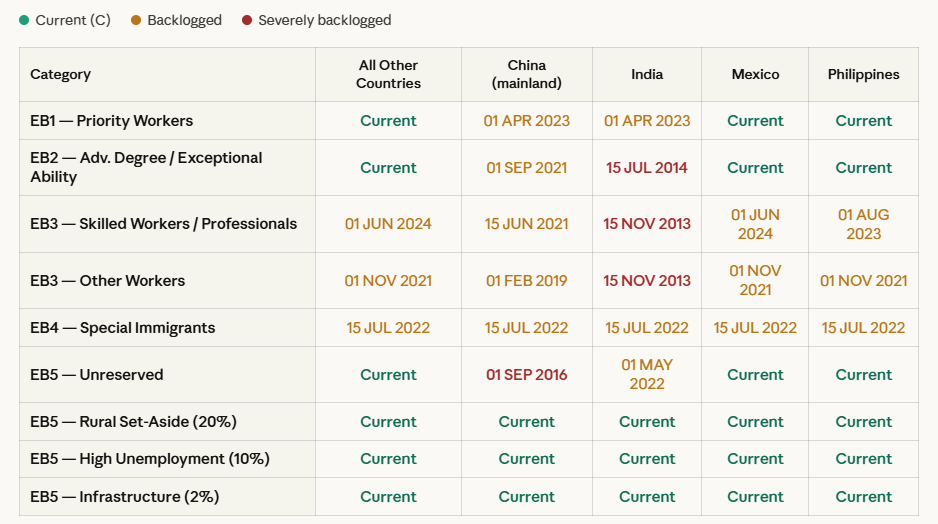
EB1: Current for most of the world. India and China-born applicants face a 3-year wait. If your client is India-born and qualifies for EB1A extraordinary ability or EB1B outstanding researcher, the April 1, 2023 cutoff is still workable for many petitions filed in recent years. Worth checking priority dates now.
EB2: India at July 15, 2014 is over 11 years of backlog. Clients in this category who are India-born need a long-term strategy conversation — whether that means pursuing EB1A, exploring National Interest Waiver structuring, or modeling out EB5 set-aside as an alternative path.
EB3 (India): November 15, 2013 — over 12 years of wait. India-born EB3 clients with priority dates in 2018 or later are looking at a potentially decades-long queue under the current per-country cap structure. This is a category where proactive case strategy matters enormously.
EB5 Set-Asides: This is the standout story of the April bulletin. Rural, high unemployment, and infrastructure set-aside categories are current for every country including India and China. For Indian-born clients stuck in EB2 or EB3 backlogs who can meet the investment threshold, this deserves immediate attention. These dates will not hold indefinitely as more investors discover the set-aside pathway.
Note on date advancement: The bulletin explicitly states that these dates were advanced because visa issuance rates have slowed for certain countries under current administration enforcement actions and Presidential Proclamations. The Department of State has flagged that retrogression may be necessary later in FY2026. Act on favorable dates while they hold.
The Dates for Filing chart below reflects when applicants may submit documents in advance of visa availability, subject to USCIS authorization each month.
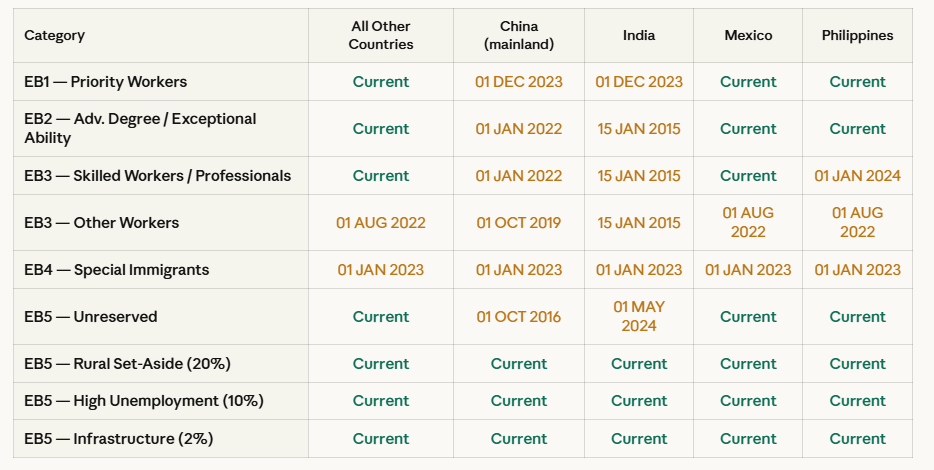
Dates for Filing vs. Final Action: The Dates for Filing dates are consistently ahead of Final Action Dates. This is the advance-filing benefit — clients can submit I-485 and related applications, establish a filing date, and trigger Employment Authorization Document and Advance Parole eligibility even before a visa number is technically available. This is strategically significant especially for India-born EB2 and EB3 clients if USCIS authorizes the chart.
India EB2 and EB3 under Dates for Filing: At January 15, 2015, India-born clients with priority dates in 2015 or earlier may be positioned to file I-485 if USCIS authorizes this chart. Confirm priority dates with your attorney and check uscis.gov/visabulletininfo monthly.
EB5 set-asides under Dates for Filing: All three set-aside categories remain current for all countries, consistent with the Final Action Dates chart. Investors who have filed or are ready to file I-526E in rural, high unemployment, or infrastructure projects are in the most advantageous position in the entire employment-based queue this month.
The standout story in employment-based categories this month is EB5 set-asides. Rural, high unemployment, and infrastructure reserved visa categories are current for every country, including India and China, across both charts. For India-born clients navigating multi-year EB2 and EB3 backlogs, this is a pathway that warrants serious evaluation now.
Family-Sponsored Priority Dates for April 2026
Family preference categories remain heavily backlogged for Mexico and the Philippines across all preference classes. F2A, covering spouses and children of permanent residents, is current across all countries in the Dates for Filing chart, which may open immediate EAD and Advance Parole eligibility for eligible applicants if USCIS authorizes that chart this month.
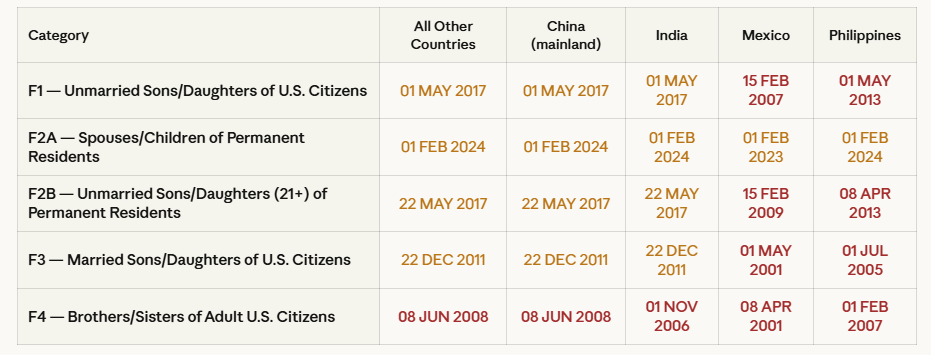
F2A: The most actionable family-sponsored category this month. Spouses and children of LPRs are at February 1, 2024 for most countries. For Mexico it is February 1, 2023. If the Dates for Filing chart is authorized by USCIS this month (see below), F2A is current meaning eligible applicants can file regardless of priority date. This is a meaningful filing window for LPR sponsors with qualifying family members.
Mexico and Philippines across all categories: The backlogs for Mexico and the Philippines in family-sponsored categories are severe across the board. F3 for Mexico sits at May 1, 2001 — a 25-year wait. F4 for Mexico is April 8, 2001. These families need realistic timeline counseling paired with any available parallel strategies such as naturalization acceleration where eligible.
F4 globally: Brothers and sisters of U.S. citizens are now at June 8, 2008 for most countries. At nearly 18 years of backlog, this remains one of the most congested preference categories in the family-sponsored system.
Family Sponsored Dates for Filing- April 2026
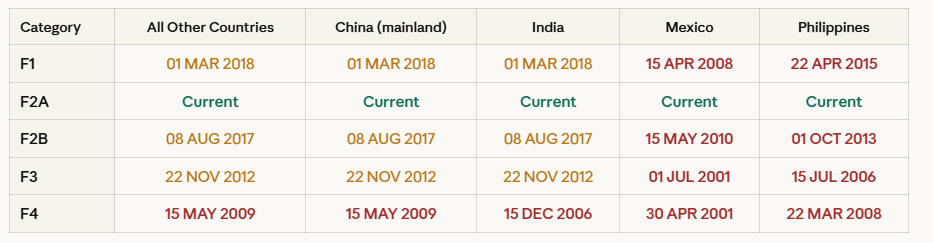
F2A under Dates for Filing: F2A is current across all countries in this chart. If USCIS authorizes use of the Dates for Filing chart this month, every F2A applicant regardless of priority date may be eligible to file I-485. This also means immediate eligibility for EAD and Advance Parole upon filing — a significant benefit for eligible family members of LPRs who are currently working on nonimmigrant status.
Reminder on the Dates for Filing chart: Filing under this chart establishes a receipt date and triggers EAD and Advance Parole eligibility, but the green card itself cannot be approved until the Final Action Date is also reached. Clients should understand this distinction before filing.
An Important Note on Advancing Dates
The bulletin itself explains that dates for several categories have been advanced because immigrant visa issuance rates have slowed for certain countries due to administration enforcement actions and Presidential Proclamations. The Department of State has flagged that retrogression may occur later in the fiscal year as demand patterns shift. This is not a guarantee of permanence. Act when dates are favorable.
What This Means for Your Case
Priority date movement, whether forward or backward, affects the timing of every step in your green card process. If you are India-born in an EB2 or EB3 category, your wait remains substantial. If you are in an EB1 or EB5 set-aside category, current windows may represent actionable opportunities today. Our attorneys analyze these bulletins not just for what they say but for what they signal about strategy.
